
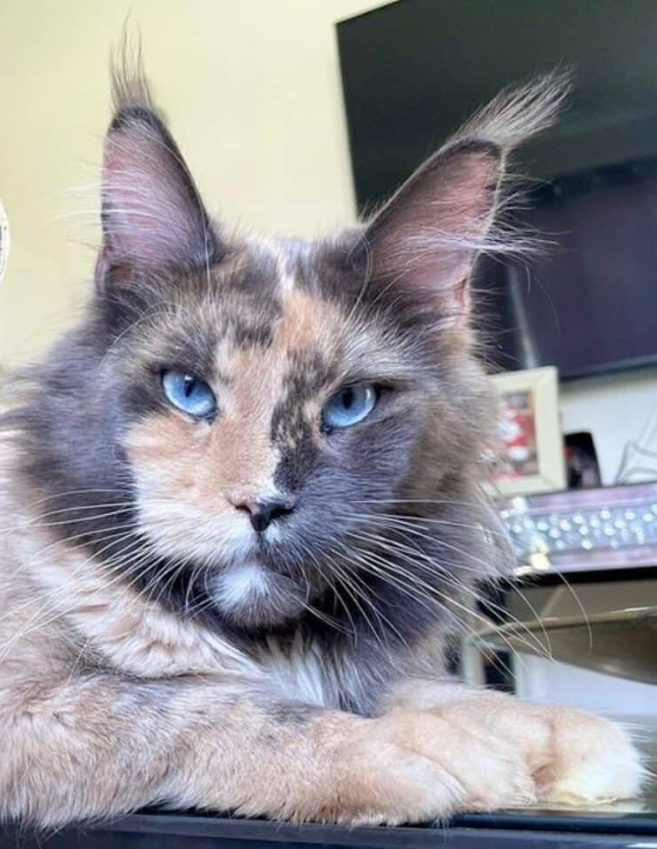
Why I Do Not Breed Dominant Blue Eyed (DBE) Maine Coons
I want to be very clear from the start: this statement is NOT referring to natural blue or odd eyes that can occur in Maine Coons with a high amount of white spotting. Those eyes are caused by white-spotting genetics and are well understood. This is specifically about the Dominant Blue Eyed (DBE) mutation gene, which is entirely different.
The Dominant Blue Eyed mutation is not simply a cosmetic eye-color trait. Research has shown that DBE is linked to developmental pathways involving pigment cells, which also play a critical role in inner ear formation. Because of this connection, DBE has been associated with sensorineural deafness in certain Maine Coon lines (Jagannathan et al.,2023). Scientific studies examining DBE Maine Coons have identified variants in the PAX3 gene within some DBE lineages. These variants are associated with auditory–pigmentary disorders, similar in concept to Waardenburg-type conditions in humans. In affected DBE Maine Coons, BAER hearing tests have documented reduced or absent responses to sound stimuli, confirming the presence of hearing impairment in some DBE cats (Bauer et al., 2024).
For me, the existence of documented deafness tied to this mutation alone is reason enough not to breed it. Breeding should always prioritize health and welfare over appearance, especially when the risks are known and avoidable. Another major concern is the inheritance pattern of DBE. The trait is autosomal dominant, and historical reports across breeds and DBE research lines describe severe outcomes when DBE cats are bred together. These reports include white kittens with serious developmental abnormalities and early mortality (Jagannathan et al., 2023). While not every DBE cat will experience severe outcomes, the risk increases when breeders intentionally propagate the mutation.
Compounding the concern is the fact that DBE is not caused by a single, universally consistent genetic variant. Multiple DBE-associated variants have been identified in different lineages. This means that claims of “safe DBE lines” are not supported by long-term, comprehensive scientific data (Jagannathan et al., 2023). The genetic uncertainty adds an additional layer of risk that I am not willing to accept.
Major international cat-fancy organizations have also raised clear welfare concerns. The FIFe Maine Coon Breed Council has formally recommended that Dominant Blue Eyed cats should not be used in breeding programs and has encouraged genetic testing for PAX3-related risks in blue-eyed Maine Coons (Fédération Internationale Féline [FIFe], 2025).
These recommendations further reinforce that DBE is considered a health issue, not simply a color preference.
Why I Do Not Breed DBE
I breed Maine Coons with the goal of preserving and improving the breed’s health, temperament, and longevity. I will not intentionally introduce or maintain a mutation that has documented links to hearing loss (Bauer et al., 2024). I will not breed a trait with known historical associations to severe developmental abnormalities, especially when the genetics are still being actively researched and are not fully understood. And I will never prioritize a rare or exotic appearance over the long-term well-being of the cats I produce.
For potential buyers, I strongly encourage asking critical questions when encountering “dominant blue eyed” cats marketed as rare or premium. Understanding the genetics behind the trait, the health testing performed, and the broader welfare implications is essential.
At Criss Castle Maine Coon Cattery, Dominant Blue Eyed mutations are a hard no. This decision is rooted in ethics, science, and a commitment to responsible breeding.
References
Bauer, A., Jagannathan, V., Drögemüller, C., Leeb, T., & collaborators. (2024). A dominant PAX3 variant is associated with blue eyes and deafness in Maine Coon cats. *Genes*, 15(2), 234. https://doi.org/10.3390/genes15020234
Jagannathan, V., Drögemüller, C., & Leeb, T. (2023). Dominant blue eyes and auditory-pigmentary disorders in domestic cats. *Frontiers in Genetics*, 14, 1289456. https://doi.org/10.3389/fgene.2023.1289456
Fédération Internationale Féline (FIFe). (2025). *DBE – A call for responsible breeding.* FIFe Maine Coon Breed Council.